KCO-Fiver-MTP-MPO-QSFP-Banner-page-1

SFP+/QSFP

SFP vs QSFP
SFP QSFP
SFP (Small Form-factor Pluggable) transceiver utilizes a single channel to transmit and receive data A QSFP (Quad Small Form-factor Pluggable) combines four channels into one module to achieve four times the bandwidth.
SFP (1 Lane): Features a small footprint with a single lane for transmitting (Tx) and receiving (Rx). It traditionally uses LC duplex or SC simplex connectors. QSFP (4 Lanes): Features a wider footprint. It houses four independent transmit and four independent receive channels. It typically uses high-density MPO/MTP connectors (for parallel optics) or an internal multiplexer over LC duplex (for Wavelength Division Multiplexing).
Form Factor Primary Data Rates Common Standard / Types Typical Use Cases
SFP 1 Gbps 1G SFP Legacy enterprise links
SFP+ 10 Gbps 10G SFP+ Modern enterprise cores
SFP28 25 Gbps 25G SFP28 5G FTTA / Data centers
SFP56 50 Gbps 50G SFP56 Mid-haul wireless, specialized compute
QSFP+ 40 Gbps (4 x 10G) 40G Base-SR4 / LR4 Enterprise distribution layers
QSFP28 100 Gbps (4 x 25G) 100G Base-SR4 / LR4 Data center leaf-spine fabrics
QSFP56 200 Gbps (4 x 50G) 200G FR4 / DR4 AI clusters and cloud infrastructure
KCO-GLC-EX-SMD 1000BASE-EX SFP 1310nm 40km DOM Duplex LC SMF Fiber Optic Transceiver Module

KCO-GLC-EX-SMD 1000BASE-EX SFP 1310nm 40km DOM Duplex LC SMF Fiber Optic Transceiver Module

- Up to 1.25Gb/s Data Links

- Hot-Pluggable

- 1310nm DFB laser transmitter

- Duplex LC connector

- Up to 40 km on 9/125μm SMF

- Single +3.3V Power Supply

- Low power dissipation <1W typically

- Commercial operating temperature range: 0°C to 70°C

- RoHS compliant

- Compliant with SFF-8472

1.25Gb/s 1310nm Single-mode SFP Transceiver

1.25Gb/s 1310nm Single-mode SFP Transceiver

Small Form Factor Pluggable (SFP) transceivers are compatible with the Small Form Factor Pluggable Multi-Sourcing Agreement (MSA). The transceiver consists of four sections: the LD driver, the limiting amplifier, the FP laser and the PIN photo-detector. The module data link up to 20km in 9/125um single mode fiber.

The optical output can be disabled by a TTL logic high-level input of Tx Disable. Tx Fault is provided to indicate that degradation of the laser. Loss of signal (LOS) output is provided to indicate the loss of an input optical signal of receiver or the link status with partner.

1.25Gb/s 850nm Multi-mode SFP Transceiver

1.25Gb/s 850nm Multi-mode SFP Transceiver

The KCO-SFP-MM-1.25-550-01 Small Form Factor Pluggable (SFP) transceivers are compatible with the Small Form Factor Pluggable Multi-Sourcing Agreement (MSA).

The transceiver consists of four sections: the LD driver, the limiting amplifier, the VCSEL laser and the PIN photo-detector. The module data link up to 550m in 50/125um multimode fiber.

The optical output can be disabled by a TTL logic high-level input of Tx Disable. Tx Fault is provided to indicate that degradation of the laser. Loss of signal (LOS) output is provided to indicate the loss of an input optical signal of receiver or the link status with partner.

KCO SFP GE T 1000M 1.25G RJ45 Copper Connector 100m Optical Transceiver Module

KCO SFP GE T 1000M 1.25G RJ45 Copper Connector 100m Optical Transceiver Module

KCO SFP GE T 1000M 1.25G RJ45 Copper Connector 30m Optical Transceiver Module

is compatible for Cisco GLC-T / GLC-TE/SFP-GE-T, Mikrotik S-RJ01

The KCO SFP GE T is a Cisco SFP-GE-T compatible copper transceiver module that has been designed, programmed and tested to work with Cisco brand switches and routers. It delivers dependable 1GbE (1000 Mbps) connectivity over copper cable, for 1000BASE-T compliant networks, with a maximum distance of up to 100 m.

KCO-SFP+-10G-ER 10Gb/s 1550nm SFP+ 40kmTransceiver

KCO-SFP+-10G-ER 10Gb/s 1550nm SFP+ 40kmTransceiver

KCO SFP+ 10G ER is a standard for 10 Gigabit Ethernet over fiber optic cables, specifically designed for long-distance transmission.

It allows for data transfer up to 40 km over single-mode fiber (SMF) at a wavelength of 1550nm.

KCO SFP+ 10G ER fiber optic modules, often implemented as SFP+ transceivers, are used in various applications where extended reach is needed, such as connecting buildings on a large campus or within a metropolitan area network.

10Gb/s SFP+ Transceiver Hot Pluggable, Duplex LC, +3.3V, 1310nm DFB/PIN, Single mode, 10km

10Gb/s SFP+ Transceiver Hot Pluggable, Duplex LC, +3.3V, 1310nm DFB/PIN, Single mode, 10km

KCO-SFP+-10G-LR is a very compact 10Gb/s optical transceiver module for serial optical communication applications at 10Gb/s, inter-converting the 10Gb/s serial electrical data stream with the 10Gb/s optical signal.

KCO-SFP+-SR 10Gb/s 850nm Multi-mode SFP+ Transceiver

KCO-SFP+-SR 10Gb/s 850nm Multi-mode SFP+ Transceiver

Up to 11.1Gbps Data Links
Up to 300m transmission on MMF
Power dissipation < 1W
VSCEL laser and PIN receiver
Metal enclosure, for lower EMI
2-wire interface with integrated Digital Diagnostic monitoring
Hot-pluggable SFP+ footprint
Specifications compliant with SFF 8472
Compliant with SFP+ MSA with LC connector
Single 3.3V power supply
Case operating temperature range:0°C to 70°C

KCO-25G-SFP28-LR 25Gb/s BIDI SFP28 SM 10KM Transceiver

KCO-25G-SFP28-LR 25Gb/s BIDI SFP28 SM 10KM Transceiver

Single LC connector Support up to 25Gb/s bit rates

Compliant with SFP28 MSA

Electrical interface compliant to SFF-8431

Hot-pluggable SFP28 footprint

Built-in digital diagnostic functions

Up to 10 km on 9/125um SMF G.652

Single power supply 3.3V

RoHS6/6 compliant

Class 1 laser product complies with EN 60825-1

Operating temperature range: 0 to 70/-40℃ to 85

Power consumption <1.2W

KCO-25G-SFP28-SR LC Duplex 850nm 100m MMF 25Gb/s 850nm Multi-mode SFP28 Transceiver

KCO-25G-SFP28-SR LC Duplex 850nm 100m MMF 25Gb/s 850nm Multi-mode SFP28 Transceiver

Up to 25Gbps Data Links
Maximum link length of 70m links on OM3 or 100m links on OM4 multimode fiber
Power dissipation < 1W
VSCEL laser and PIN receiver
Metal enclosure, for lower EMI
2-wire interface with integrated Digital Diagnostic monitoring
Hot-pluggable SFP28 footprint
Specifications compliant with SFF 8472
Compliant with SFP28 MSA with LC connector
Single 3.3V power supply
Case operating temperature range: Commercial: 0°C to +70°C

KCO QSFP+ 40G ER4 40Gb/s QSFP+ SMF 1310 40km Transceiver

KCO QSFP+ 40G ER4 40Gb/s QSFP+ SMF 1310 40km Transceiver

4 CWDM lanes Mux/Demux design

Up to 11.1Gbps Data rate per wavelength

Up to 40km transmission on SMF with FEC.

Electrically hot-pluggable

Digital Diagnostics Monitoring Interface

Compliant with QSFP+ MSA with LC connector

Case operating temperature range:0°C to 70°C

Power dissipation < 3.5 W

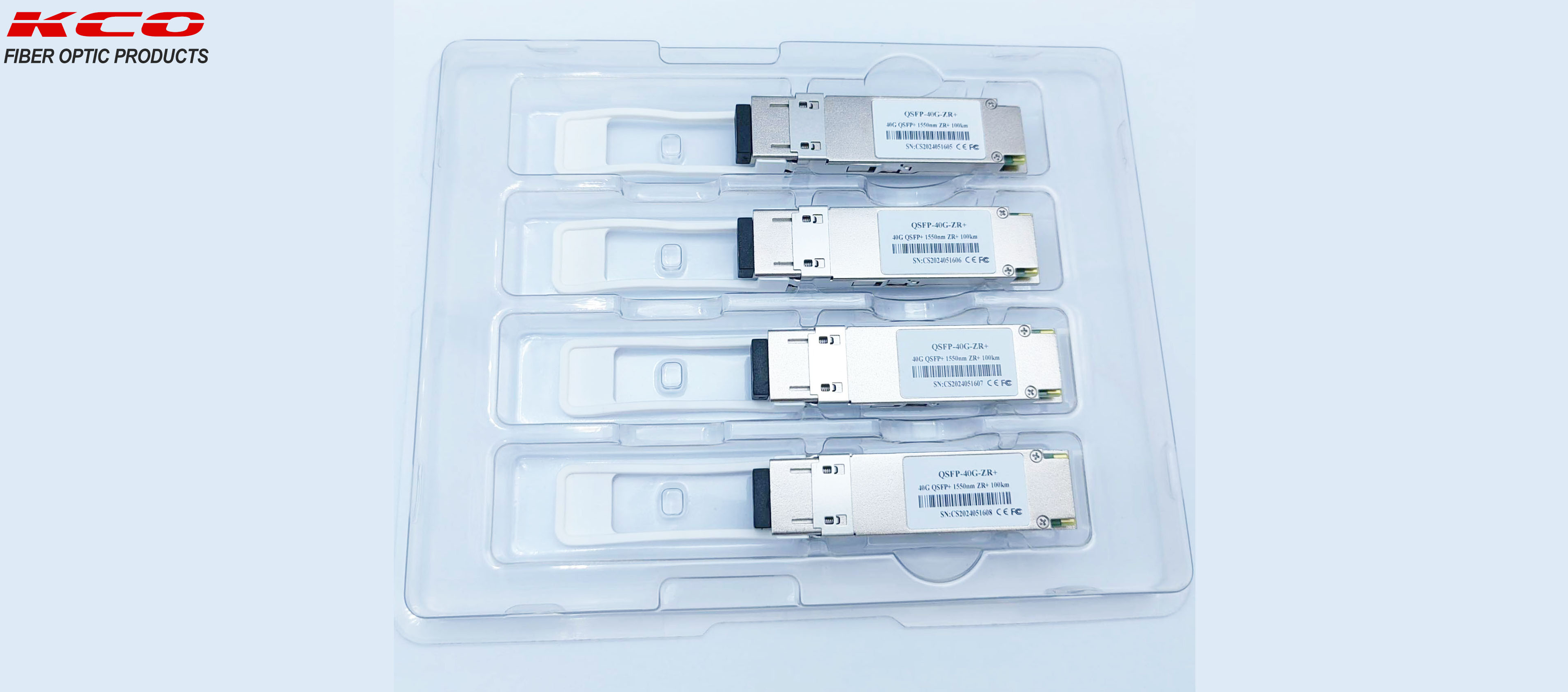
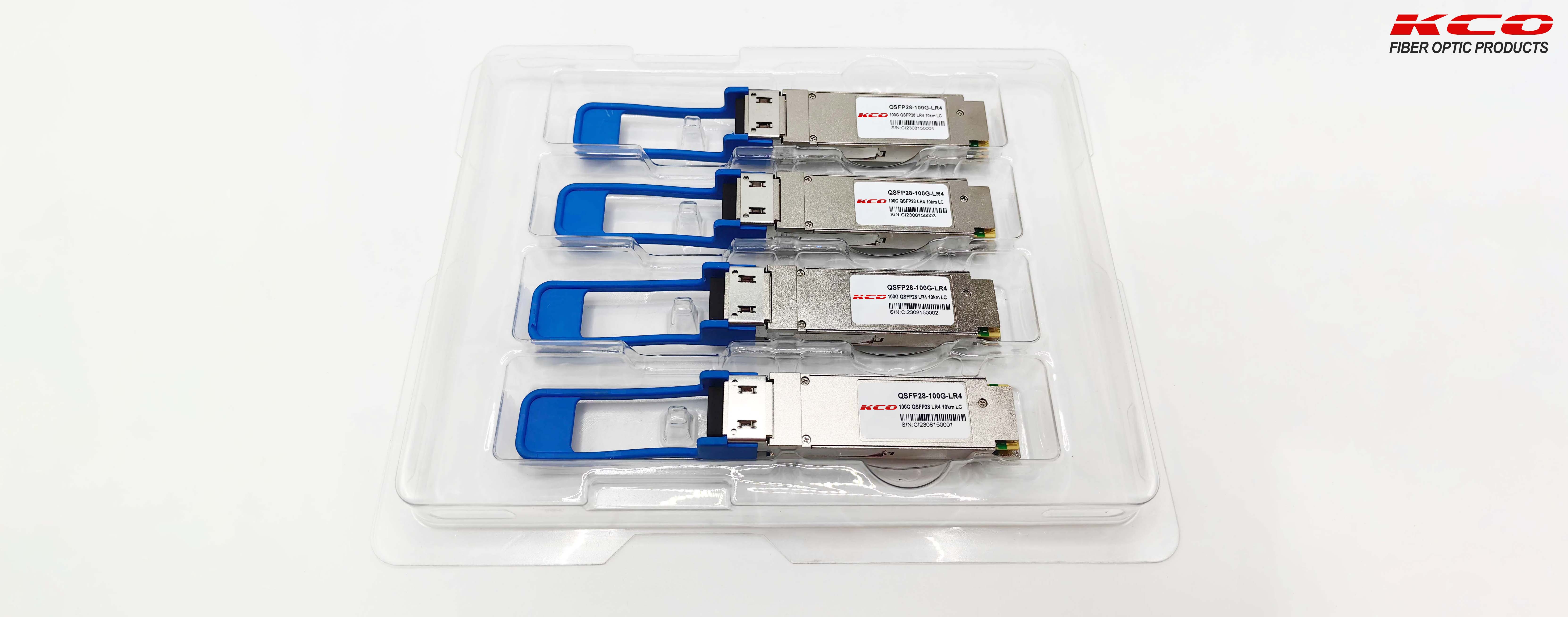
KCO QSFP+ 40G LR4 LC 40Gb/s QSFP+ LR4 SMF 10km LC Transceiver

KCO QSFP+ 40G LR4 LC 40Gb/s QSFP+ LR4 SMF 10km LC Transceiver

What is QSFP+ 40G LR4

A 40G QSFP+ LR4 is a hot-pluggable optical transceiver module for 40 Gigabit Ethernet (40GbE) that uses single-mode fiber to transmit data up to 10 kilometers. It operates by combining four separate 10G channels onto two strands of single-mode fiber using CWDM technology, which is then separated back into four 10G channels on the receiving end. This module is known for its high-density connectivity, small form factor.

KCO QSFP+ 40G PLR4 SMF 1310 10km MPO 40GBASE PSM4 LR PLR4 QSFP+ SMF 1310nm 10km MTP/MPO Connector  Optical Transceiver Module

KCO QSFP+ 40G PLR4 SMF 1310 10km MPO 40GBASE PSM4 LR PLR4 QSFP+ SMF 1310nm 10km MTP/MPO Connector Optical Transceiver Module

* Compliant with QSFP MSA

* Single +3.3V power supply

* Commercial operating temperature: 0oCto +70oC

* MPO/MTP connector

* RoHS Compliant

123 Next > >> Page 1 / 3

The usage of SFP and QSFP on FTTH and FTTA Solution

 Design Metric  FTTH (Fiber-to-the-Home)  FTTA (Fiber-to-the-Antenna)
 Edge Module (SFP)  GPON / XGS-PON SFP (Simplex SC)  25G SFP28 eCPRI (Duplex or BiDi LC)
 Core Module (QSFP)  QSFP28 / QSFP-DD Network Uplinks  QSFP28 Port-to-SFP28 Radio Breakouts
 Primary Protocol  Ethernet / ATM Layering  CPRI (4G) / eCPRI (5G Packetized)
 Temp Requirement  Commercial (0°C to 70°C) inside CO  Industrial (-40°C to 85°C) up the mast
 Usage [ Central Office OLT ] ===( QSFP Uplink )===> [ Core Switch ]
|
( PON SFP )
|
[ Passive Splitter ] ——> [ Home ONT / ONU ]
 [ BBU Hub / DU ] ===( QSFP28 Breakout )===> [ 4x SFP28 Tower Ports ]
||
( Vertical Trunk )
||
[ 25G SFP28 RRU ]
 FTTH networks rely heavily on Passive Optical Network (PON) topologies to distribute internet from a Central Office (CO) to individual homes  The SFP28 (25G) Standard: Modern 5G Macro cells run on 25G SFP28 transceivers built specifically for eCPRI (Enhanced Common Public Radio Interface) protocols.
 OLT Side: Optical Line Terminal (OLT) chassis use specialized PON SFP modules (GPON, XGS-PON, or 25G-PON). These are unique because they are BiDi (Bidirectional) simplex SFPs—using a single SC connector to transmit on one wavelength (e.g., 1490nm) and receive on another (e.g., 1310nm) to serve up to 32 or 64 homes over one fiber strand.  Industrial Hardening: SFTs deployed up the tower must be Industrial Temperature rated (-40°C to 85°C) to survive extreme seasonal weather. They are integrated into ruggedized outdoor housings like FullAXS or ODVA before being plugged directly into the Remote Radio Unit (RRU)
 ONT/ONU Side: The client-side optical network terminal inside the home or business often utilizes standard 1G SFP or 10G SFP+ modules plugged into a residential gateway.  BiDi & CWDM: To save weight and fiber resources on the tower asset, technicians frequently use BiDi SFP28 or CWDM SFP28 modules, allowing multiple frequency bands to share fewer glass strands.
 QSFP Usage (The Central Office Core: Home users do not use QSFP modules. Instead, QSFP28 (100G) or QSFP-DD (400G/800G) transceivers are used inside the Central Office. They aggregate the massive combined traffic coming from dozens of PON SFP line cards and route it upstream out to the broader internet core.  Breakout Deployments: Instead of running 24 individual SFP cables, a high-density baseband router will utilize QSFP28 (100G) ports in breakout mode. A single QSFP28 port maps out to a 1-to-4 breakout MPO trunk cable, efficiently delivering four independent 25G eCPRI channels straight up to four separate tower radios.

Process
Process
Process